A Guide for Purpose-Driven Leaders
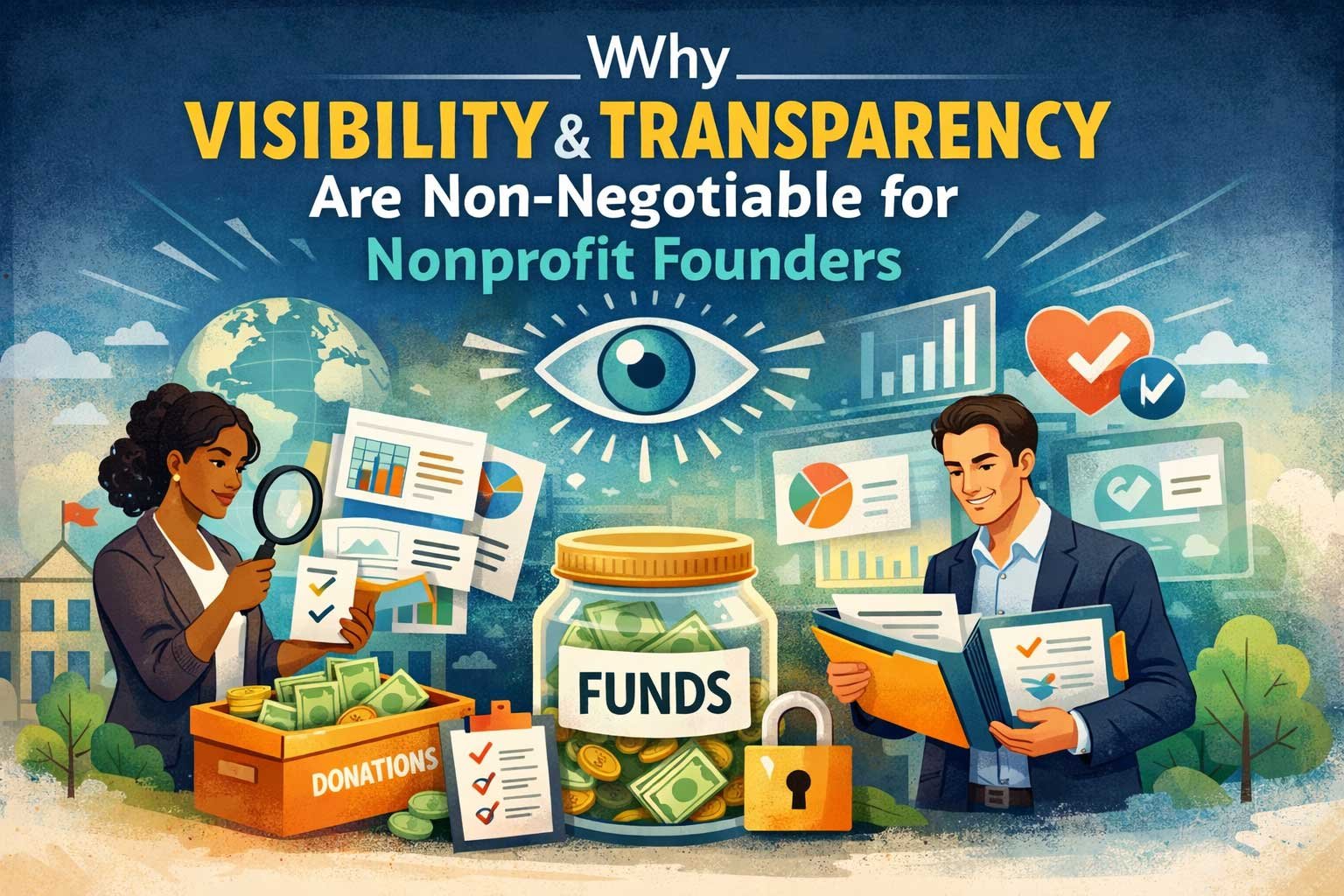
In the nonprofit world, you are not just building an organization — you are building belief. And
belief is only sustained when people can see, understand, and trust what you are doing with the
resources, relationships, and responsibility they have placed in your hands.
Visibility and transparency are not buzzwords or compliance checkboxes. They are leadership
postures — intentional choices that shape how your organization grows, how your community
responds, and how deeply your mission takes root. Here is why every nonprofit founder needs
to embrace both, fully and unapologetically.
01 — FOUNDATION
Trust Is Your Most Valuable Asset
Unlike for-profit businesses, nonprofits ask people to give — their money, their time, their
endorsement — without receiving a direct product or service in return. What donors and
volunteers receive instead is the confidence that their contribution is being used with integrity
and purpose.
That confidence is trust. And trust is not assumed; it is earned — through consistent, honest
communication about how decisions are made, how funds are allocated, and what outcomes
are being achieved. Transparency is not just good ethics. It is your most powerful fundraising
tool.
02 — ACCOUNTABILITY
You Answer to More Than a Board
A nonprofit founder operates at the intersection of multiple stakeholder groups: donors, board
members, grant-makers, beneficiaries, community partners, and the public at large. Each of
these groups has a legitimate interest in understanding how the organization operates.
Visibility — showing up consistently, communicating openly, and making your mission legible to
all stakeholders — ensures that everyone remains aligned around the same purpose. It
prevents the kind of confusion, rumor, and disconnect that quietly erodes even the most
well-intentioned organizations.
03 — GENEROSITY
People Give More When They Can See the Impact
Donor retention is one of the most significant challenges in the nonprofit sector. Many
organizations spend enormous energy acquiring new donors while losing existing ones simply
because they failed to close the loop — to show what happened as a result of someone’s
generosity.
Transparent impact reporting — stories, data, honest assessments of what worked and what did
not — transforms one-time givers into long-term partners. When donors feel like insiders rather
than ATMs, they give more, give more often, and bring others along with them.
04 — CREDIBILITY
Funders and Partners Need to Vet You
Before foundations, corporations, or government agencies award grants or enter partnerships,
they conduct due diligence. They look at your financials, your leadership, your program
outcomes, and your public presence. A founder who is visible — who has written, spoken, and
shown up in the public arena — is infinitely easier to vet and far more attractive to resource
partners.
Visibility signals that you are not hiding. It communicates that you are confident in your work and
willing to be examined. That is exactly the kind of leader institutional funders want to bet on.
05 — CULTURE
Leadership Sets the Organizational Temperature
Founders set the tone for everything that happens beneath them. When you operate with
openness — sharing your decision-making rationale, acknowledging when things go sideways,
celebrating your team’s contributions rather than centralizing the spotlight — you create a
culture of integrity that permeates the entire organization.
Conversely, when a founder operates in secrecy or projects a curated image that does not
match the internal reality, that disconnect breeds cynicism, turnover, and eventually, scandal.
Transparency at the top is not optional. It is the foundation of a healthy organizational culture.
06 — PROTECTION
Organizations with established transparency practices are less vulnerable to internal
wrongdoing and recover faster when problems do arise. Proactive openness signals that there
is nothing to hide, which is among the most powerful reputational protections a nonprofit can
have.
Openness Is Your Best Defense
We live in an era of heightened public scrutiny. Social media can surface organizational failings
in hours. A culture of secrecy — even unintentional — creates fertile ground for misconduct and
makes recovery from any misstep exponentially harder.
07 — MOVEMENT
You Are Building More Than an Organization
The most powerful nonprofits are not just service providers — they are movements. They have
communities of people who believe in the mission so deeply that they become advocates,
recruiters, and amplifiers. That kind of community is not built through brochures or annual
reports alone. It is built through the consistent, visible presence of a founder who can articulate
the why with clarity, passion, and authenticity.
When you show up — on social media, in speaking engagements, in community spaces, in
honest newsletters — you are not just marketing your organization. You are inviting people into
something larger than themselves. That is the essence of movement-building, and it only
happens in the light.
PRACTICAL STARTING POINTS
- Share your organization’s financials and annual reports publicly, not just on request
- Post regular impact updates — including what did not go as planned
- Show up personally on social media as a founder, not just as a brand account
- Write about the mission: op-eds, blog posts, newsletters, LinkedIn articles
- Be transparent in donor communications — before, during, and after campaigns
- Acknowledge your team, your partners, and your community — loudly and often
Transparency is not a burden placed on nonprofit founders — it is a superpower available to
them. It is the decision to lead in the open, to do the work in the light, and to trust that integrity,
consistently practiced, will always outlast image carefully managed.
The world needs organizations that do good. And it needs to be able to see them doing it.